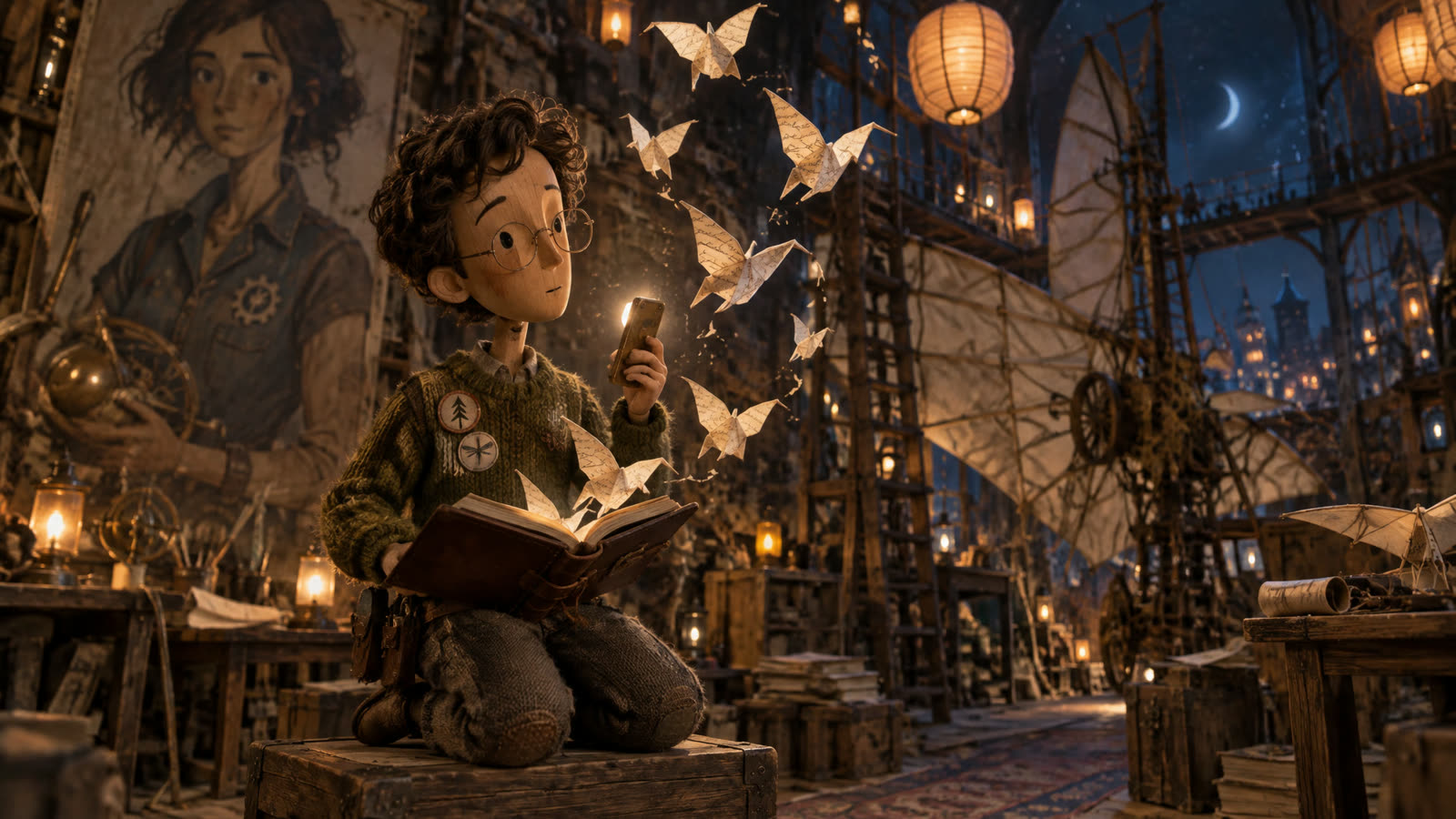
KEEPSAKE
It's about who gets their name on things.
A twelve-year-old maker who has spent six years watching the one lit window of the big house gives up his dream machine to prove that a dead inventor's greatest idea belonged to the widow at the long table, and breaks his mother's only rule to get the proof up the stairs.
Everything here was made by someone.
Keepsake is about who gets their name on things. A woman designed a famous machine in 1968 and let her husband be its face. Fifty years later the plaque still has one name on it, and a boy with a phone and a pedant's sense of justice decides it's wrong.
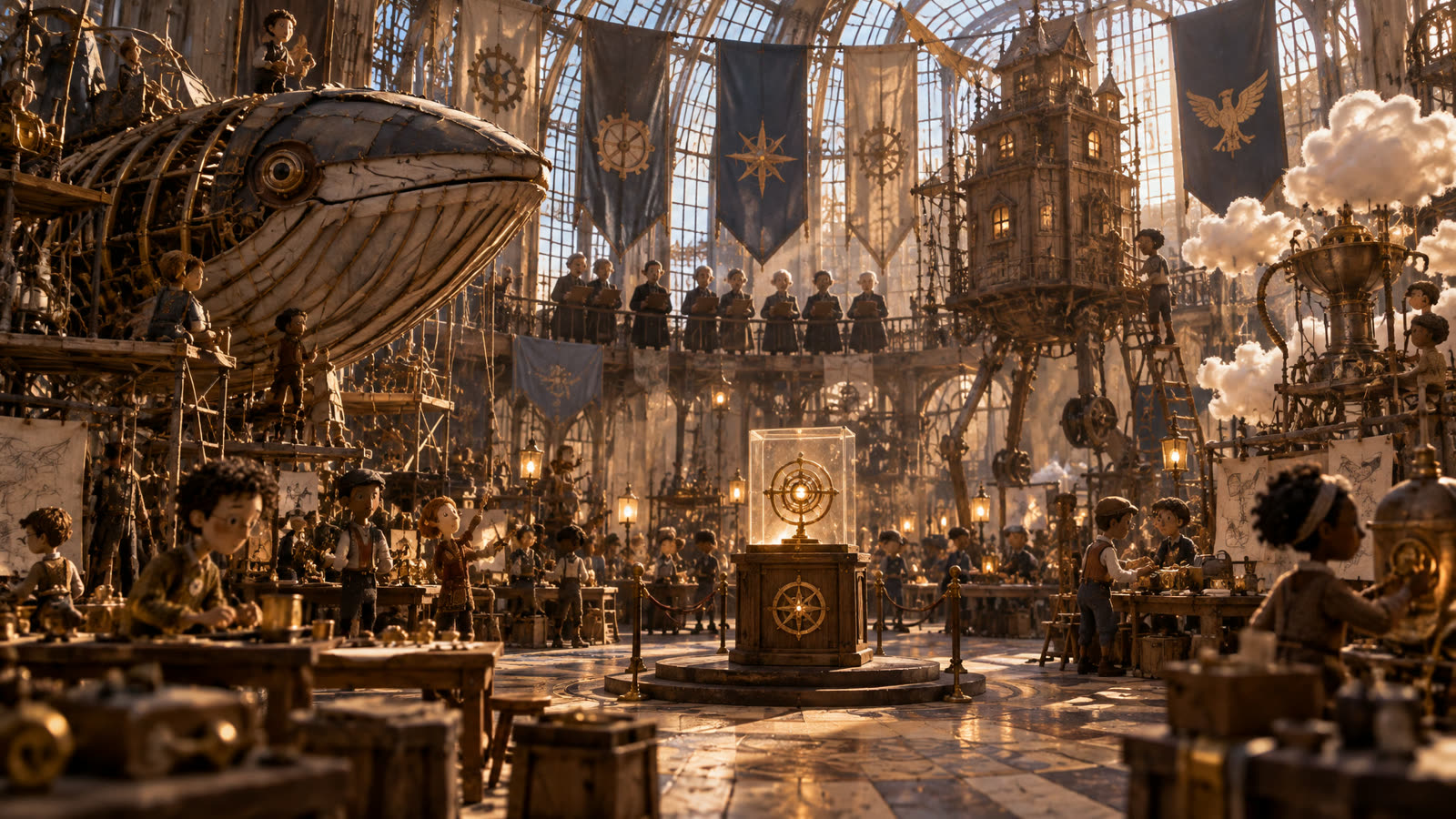
So the world is carved and knitted by hand: wooden faces lacquered until they catch the lamp, sweaters you can count the stitches in, a lawn of black felt under an indigo sky. The film makes its argument in materials. Somebody made all of this, and you can see their fingerprints.
Only words are paper. When handwriting comes alive it lifts off the page and folds into a small bird, and every writer's bird is different. That is the one piece of magic. Everything else stays tactile and still.
The camera stays at a child's height in the cottage and looks up in the big house. The comedy is played straight and comes from character. Nobody is a villain; everybody is right about something. We don't end on a hug. We end on an argument over a paper wing.
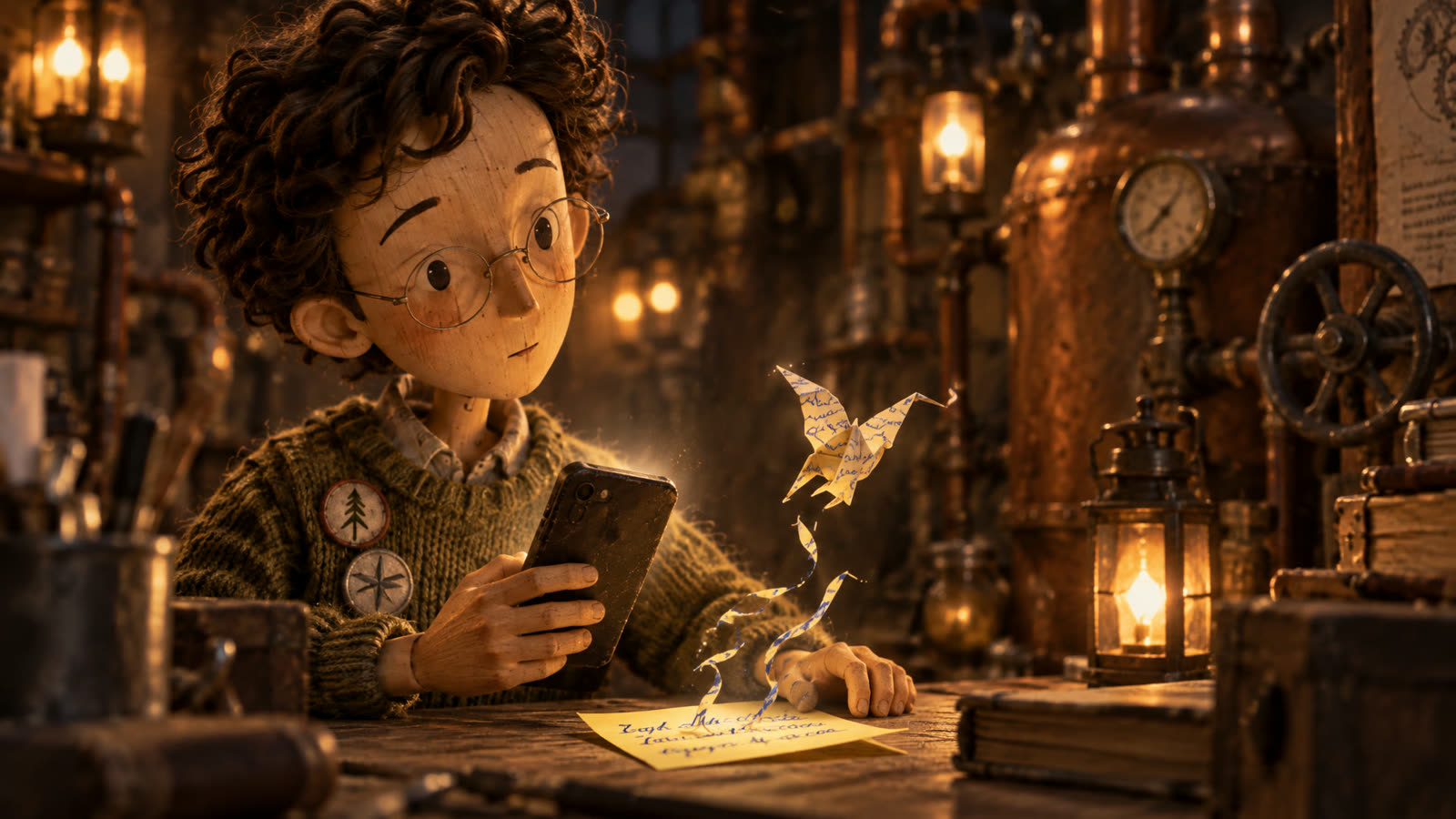
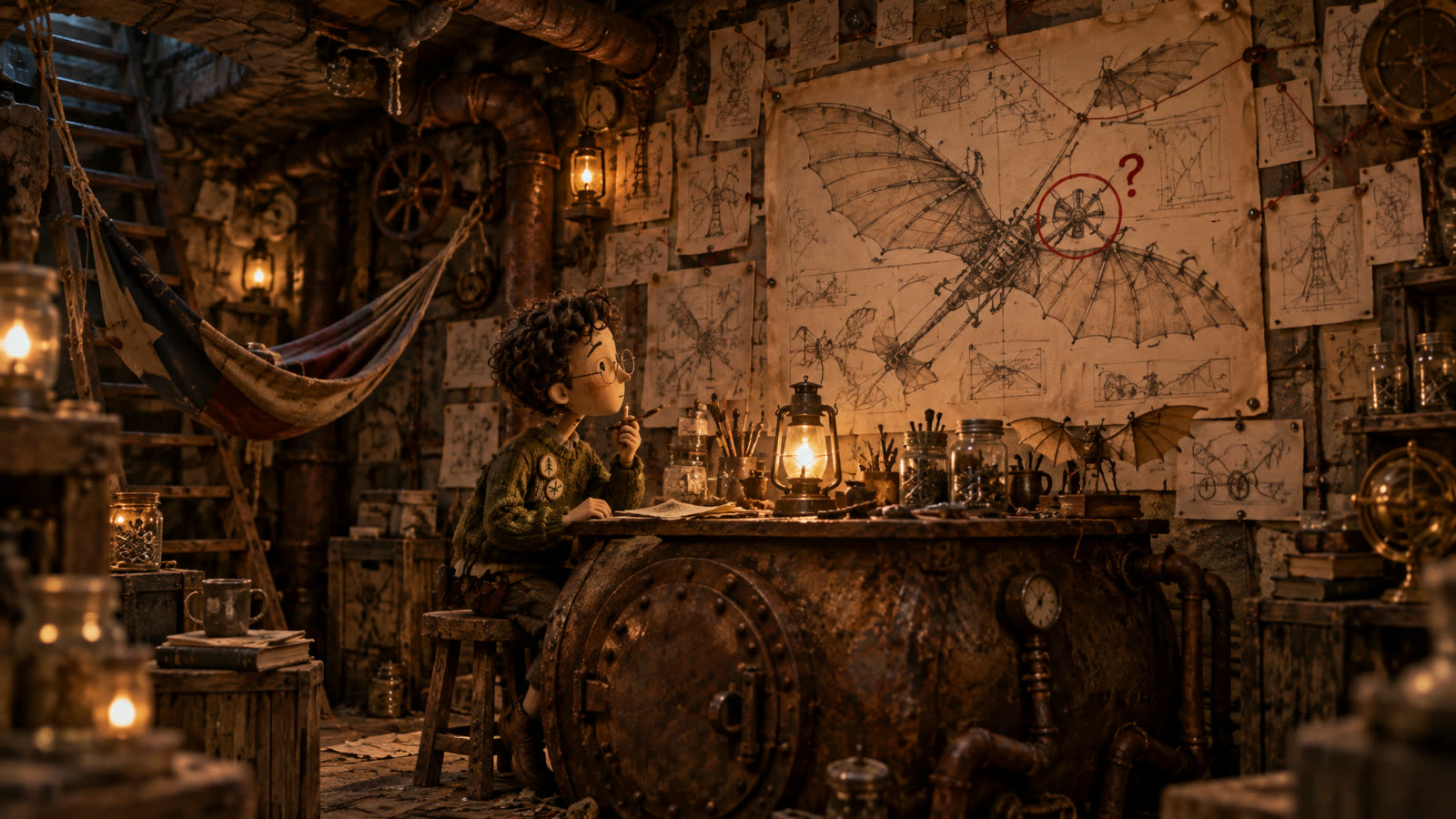
The cottage & the boiler room
Behind the garages, small and scrubbed. A fridge shingled with yellow sticky notes, a plate under foil, and under the floor a dead boiler that became a boy's workshop, papered in six years of the Heron.
Light · one desk lamp against blue walls
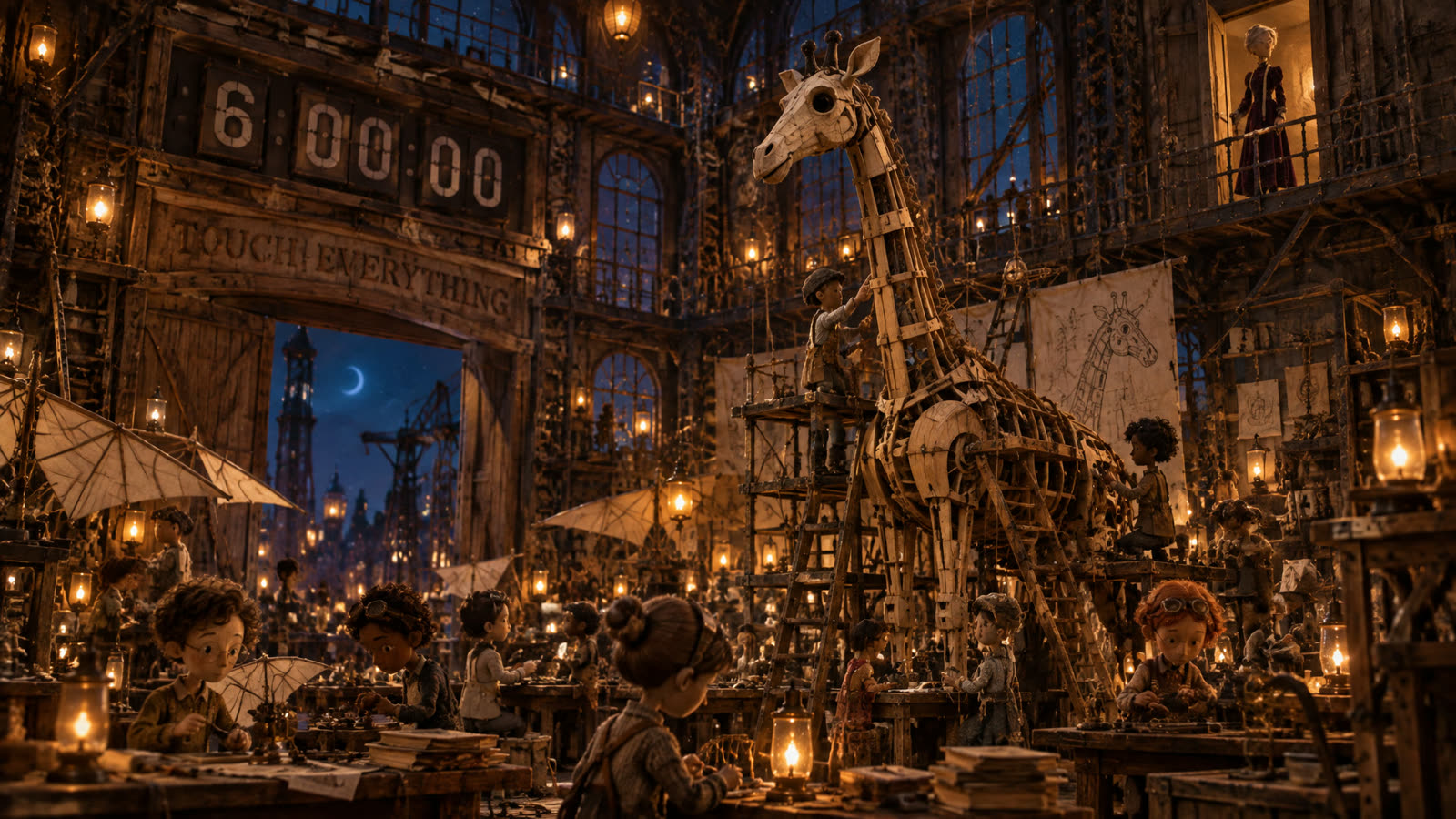
The Whitlock Workshop
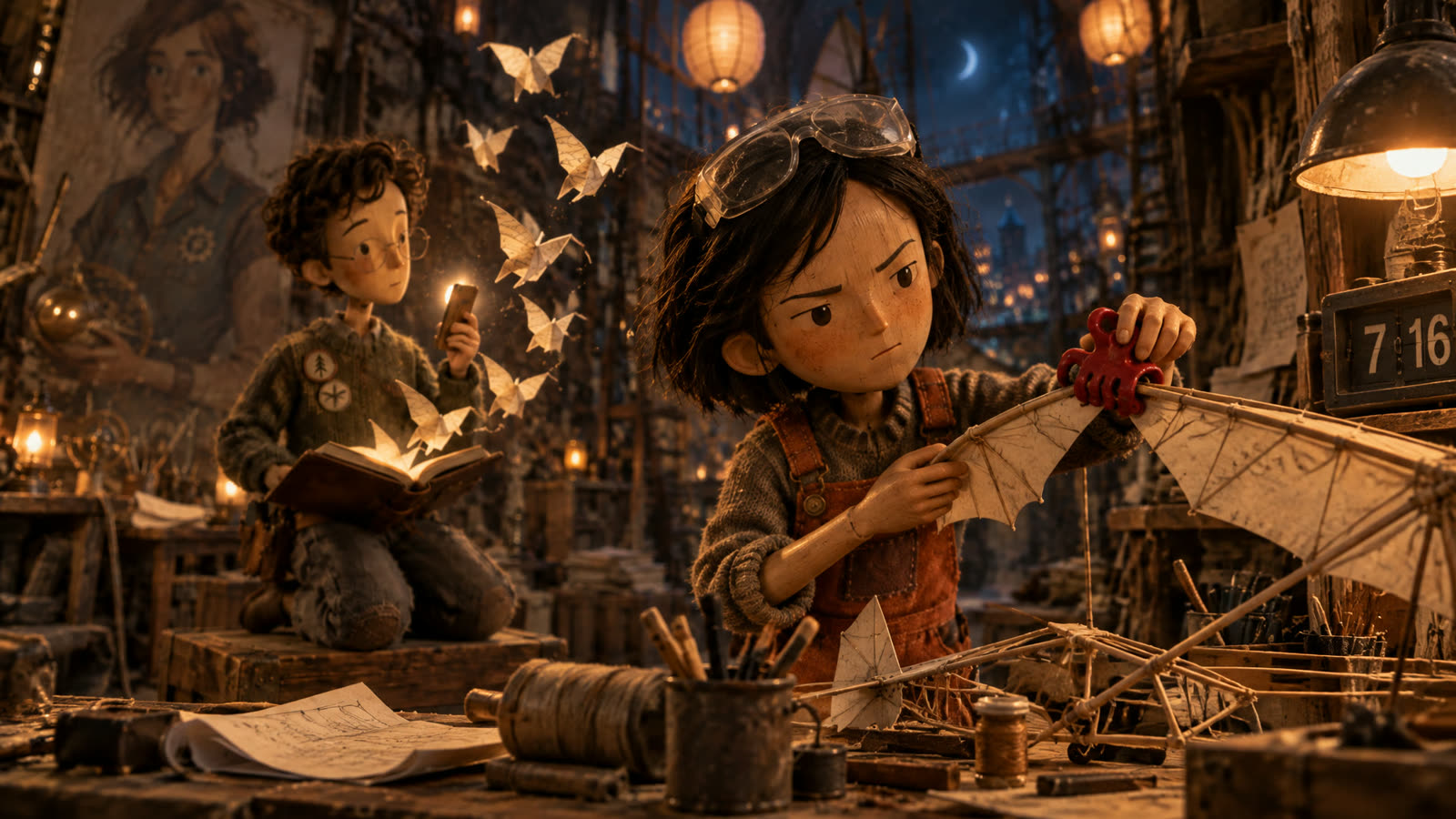
A converted hangar of lathes, looms and ladders to nowhere, under a carved motto: TOUCH EVERYTHING. A flip clock counts six hours down. Rafters high enough for a paper-winged machine to circle.
Light · lanterns by night, tall windows on Saturday
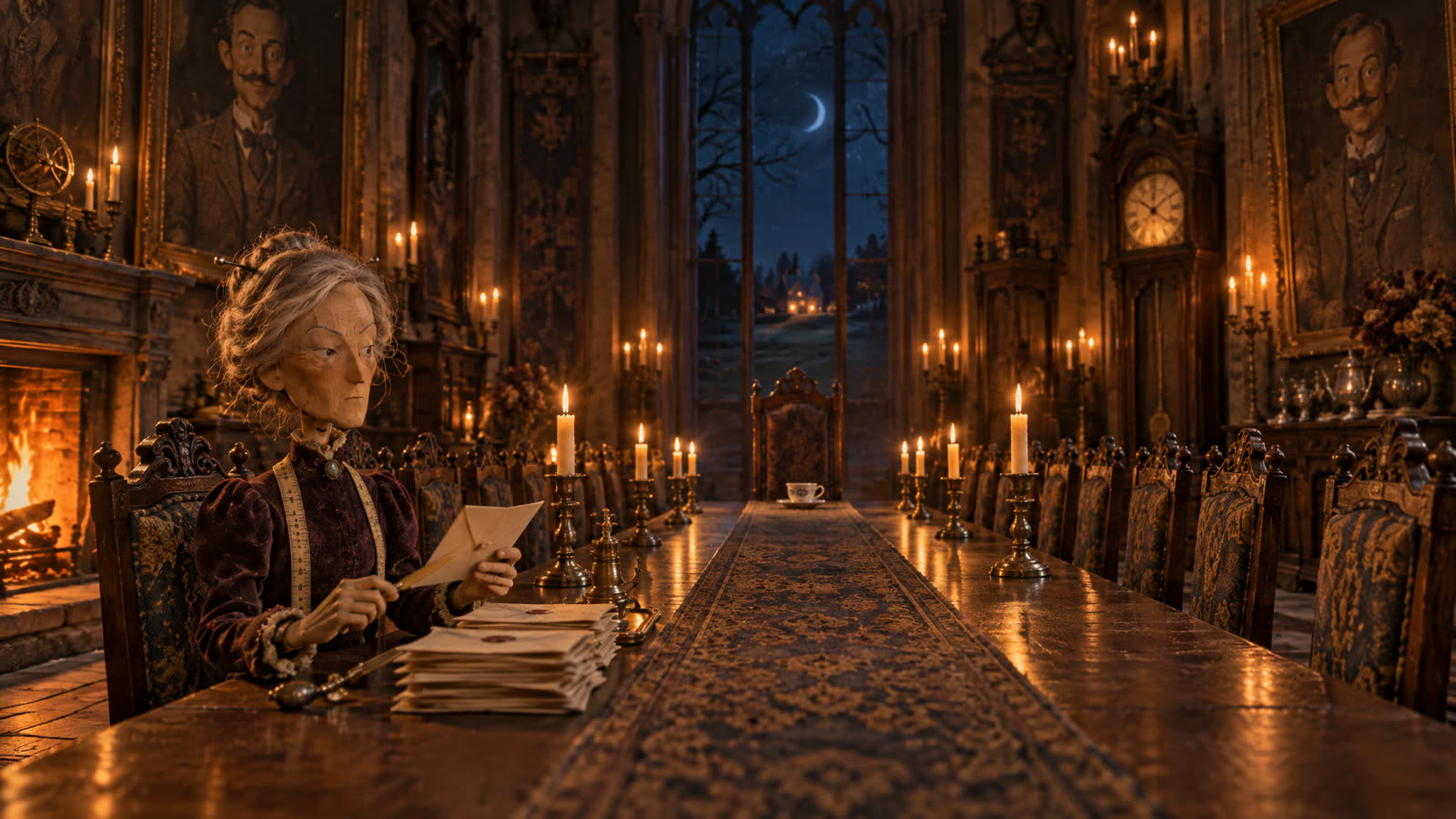
The big house
Forty windows, one lit. A vast sleeping kitchen where tile turns to dark wood: the line. A staircase that curls up like a shell. And a table long enough to land a plane, with a cup of tea carried thirty feet every night to an empty chair.
Light · fire, candles, a clock that ticks too loud
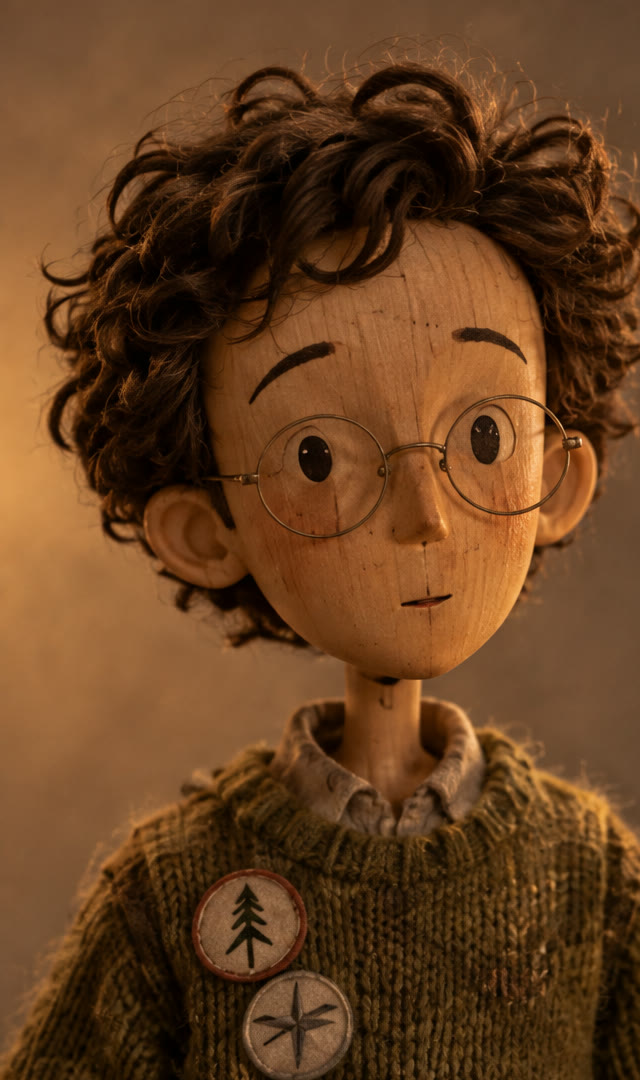
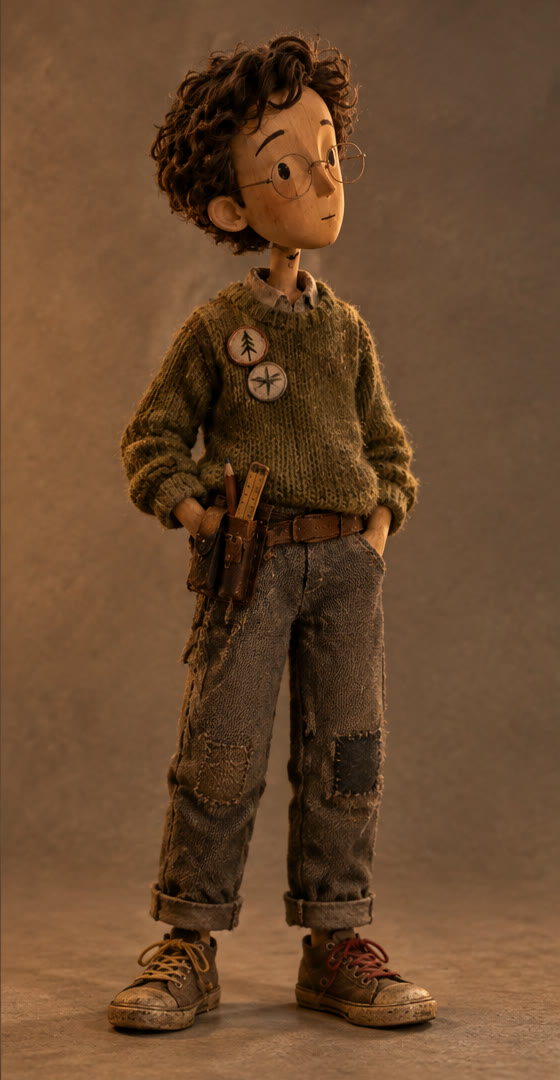
Who he is
Earnest, over-prepared, certain about things he's wrong about: his wing math, the odds, cursive being "a dead language." He awards himself felt badges because no organization exists to give them out. He's a pedant about facts, and in his hands that becomes a kind of justice.
Contradiction
He watches everyone and assumes nobody watches him. He sets a plate every night for someone who isn't there and never guesses the second plate is too.
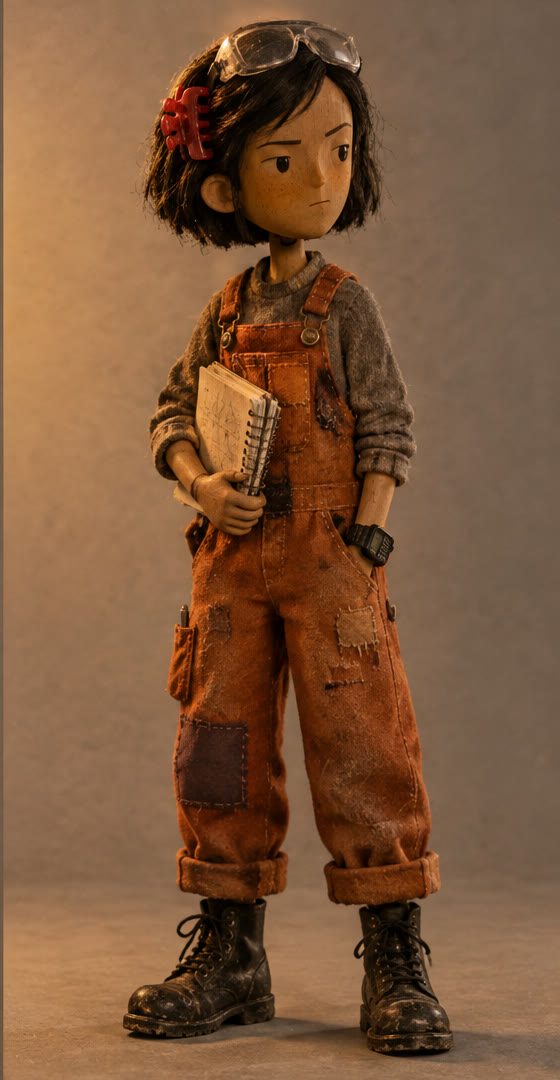
Who she is
Small, fierce and dry; quicker than Theo about everything except dreaming. Right about the wing, the judges and the odds. Two partners have quit on her. Her school's physics teacher is the swim coach, and her family's roof leaks.
Contradiction
She won't carry Theo's letter ("It's the only thing I get to say to her"), then spends every line of hers on him. She takes his dream, builds it better, wins, keeps the money, and gives the credit away in writing. She does what Arthur didn't.
Who she is
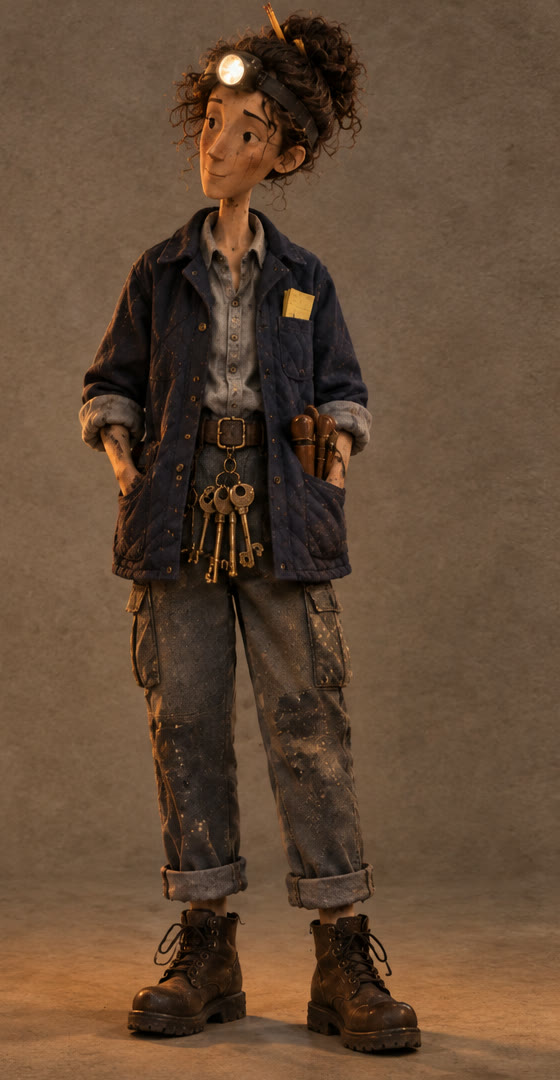
She keeps the boiler, the clocks, the fountain pumps and the fuse boxes running so the house looks effortless: the third uncredited maker in the film, and where Theo gets it from. Deadpan, practical, a vault. She was fired from a house when Theo was three, so she made a rule and let him think the house made it.
Contradiction
She won't look at his app, and she still carries his letter up the stairs and signs her own name to it. She sets a cup for a dead man every night, and eats the plate her son leaves her standing up, cold.
Who she is
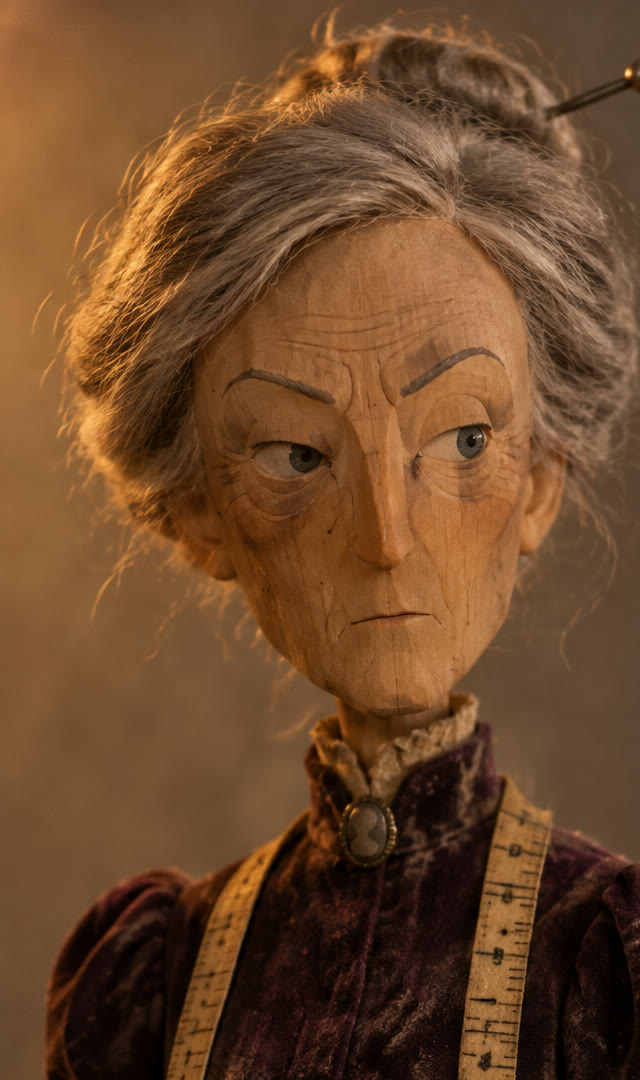
An engineer to the bone. She studies people "like a noise in an engine" and names the flaw in a design before she says hello. In 1968 nobody would fund a young woman's gyroscope, so her husband became its face. It made them rich and made her "the widow."
Contradiction
The founder who reads every letter and answers none. She wants credit and would refuse the plaque. She has never learned the name of the woman who sets her table, and she's the one who finally asks it.
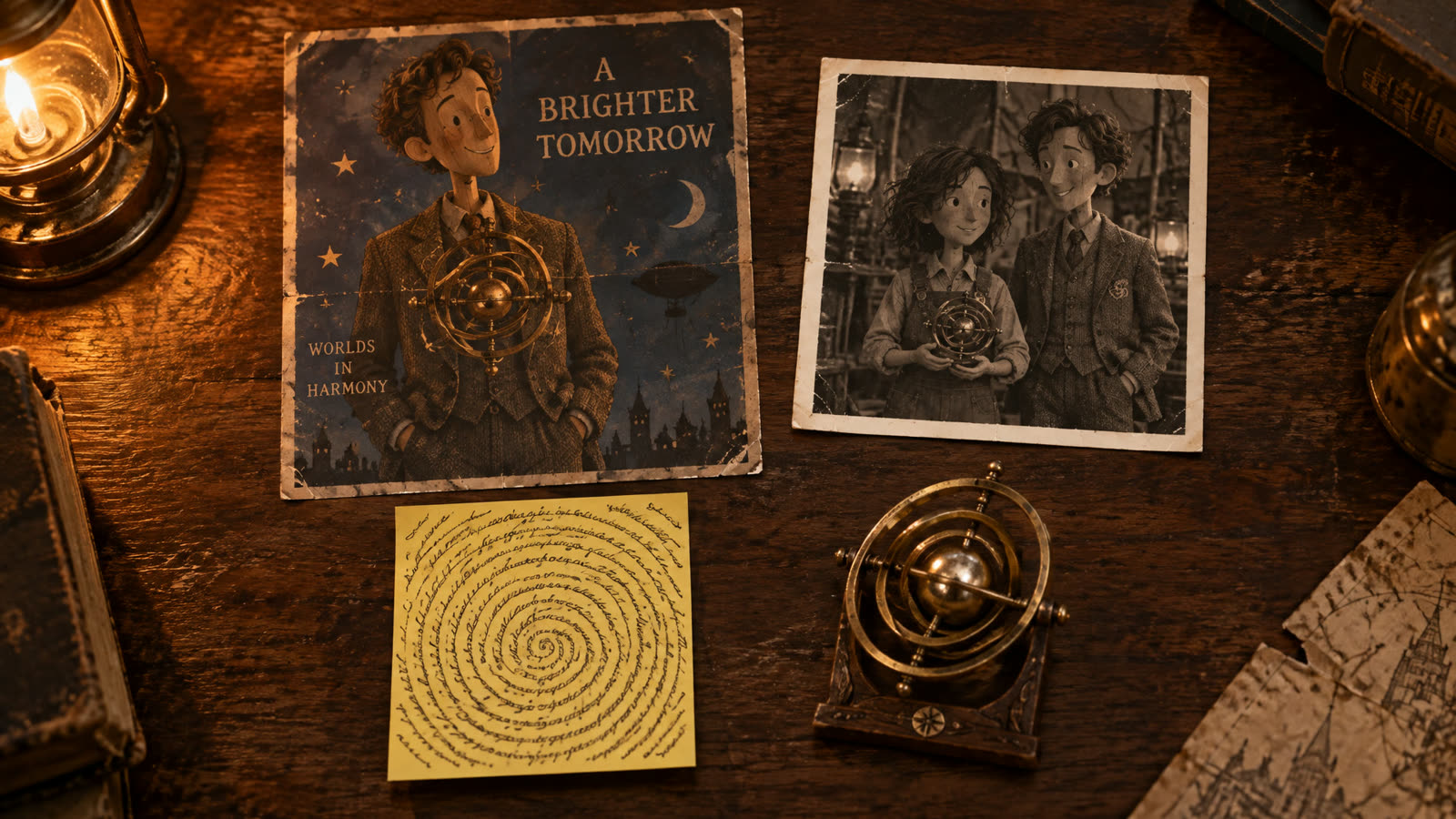
Tweed, a big grin, a warm broadcast voice. In the famous poster his hands are in his pockets and the gyroscope floats at his chest, because the hands actually holding it were cropped off at the frame. The snapshot in Notebook Nine shows the uncropped picture.
Contradiction
He isn't a villain. He was charming, a coward about credit, and he loved her in pencil, in margins nobody read, forty-one times.
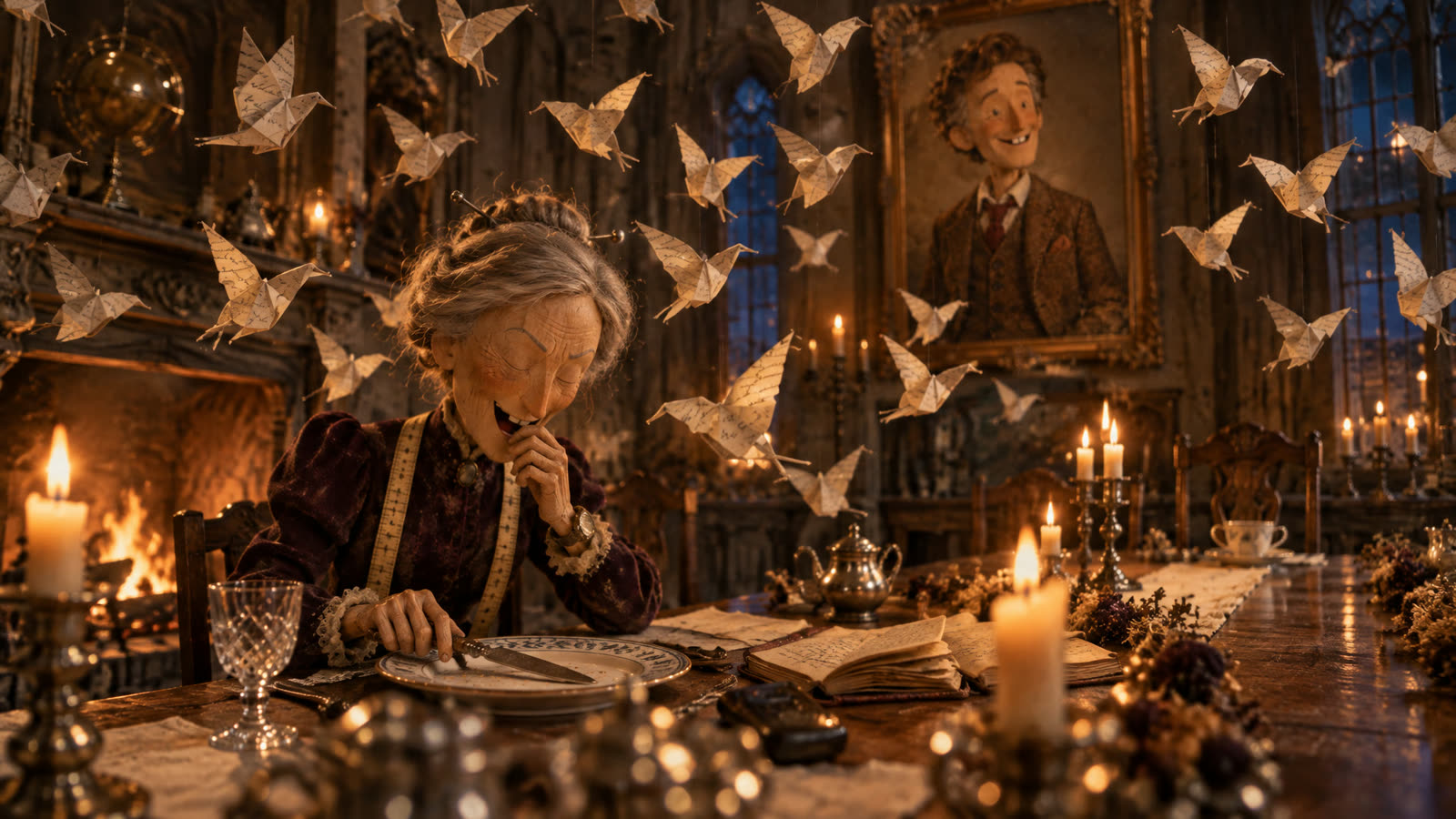
Only words are paper.
Adela
Blue ballpoint, fastQuick, rough folds, a little crumpled; lands almost at once. It speaks in a flat robot voice, because she has never read one aloud.Theo
Pencil, big printOversized and clumsy. It flaps too hard and can't fly straight.Arthur
Soft graphite, marginsSmall and grey with soft folds. Forty-one rise together like a flock off a field, in his 1974 broadcast voice, with a little tape hiss.Eleanor
Black fountain ink, a spiralThe ink unwinds in one sharp spiral from the edge to the center. Small and precise, creases like knife-edges. It barely moves.Priya
Block print, one pageNever scanned. Eleanor reads her letter aloud. She's the one character who didn't need the app.Wood, cloth, felt. And one lamp.
People and places are wood, cloth and felt. Words are paper. The light is practical: a desk lamp, a fire, one lit window, a phone. When a bird speaks it carries its own small amber glow.
The finale is the first scene in broad, even daylight, with the workshop's tall windows open.
Paper
Notebook cream with graphite that smudges. Only words and the Heron's skin are paper.
Felt & knit
Badges, sweaters, the black felt lawn. You can count the stitches.
Lacquer
Carved faces, hand-lacquered, crazing where the light catches.
Lantern
Amber pools in indigo. One source per scene where we can.
The flock
She hasn't opened one of his notebooks in nineteen years. The phone hovers; her hand isn't steady. Then the margins answer, faster and faster.
Nineteen years dead and still getting fan mail, Arthur.
You coward. Forty-one times. In pencil.
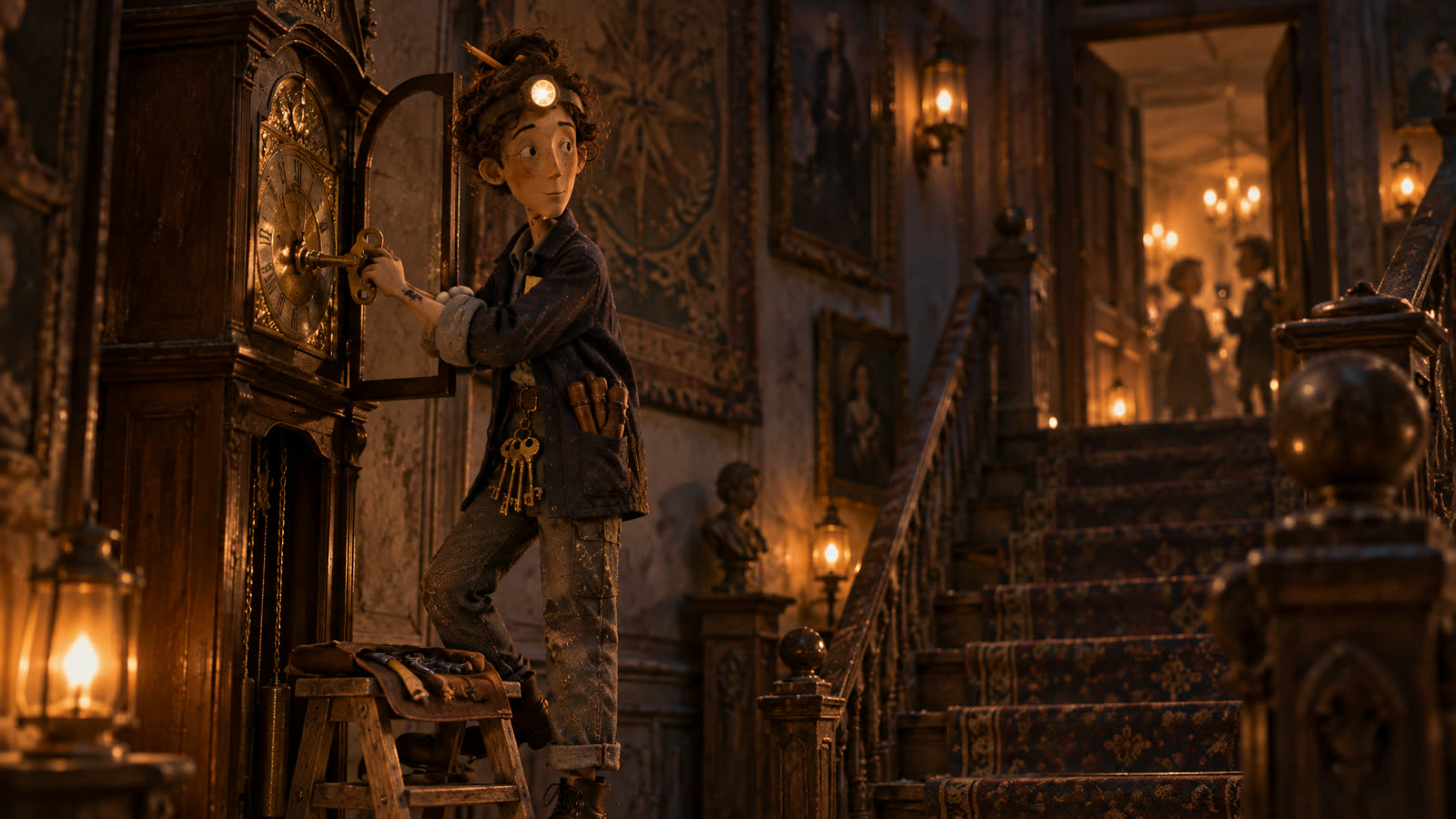
In nine years she has never heard her laugh.
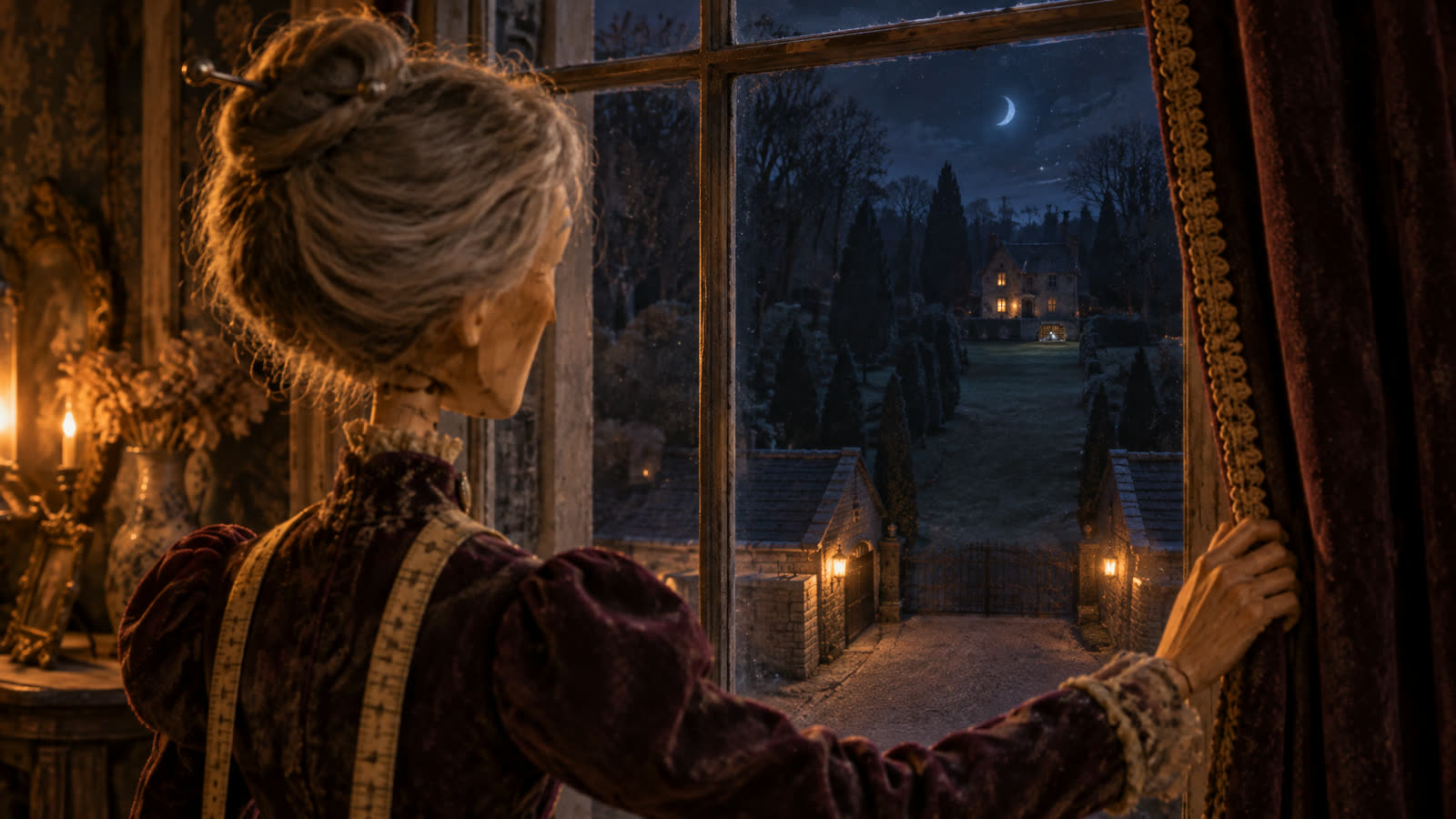
Okay.
Played straight. Kept small.
The room is the score.
The long table plays as three minutes of audio drama that works with no pictures at all. The sound defines the room; each voice has its own distance from the mic.
Music is small and handmade: a solo cello and a music box. It stays out from under the long table until the laugh, and the only large cue in the film belongs to the flock.
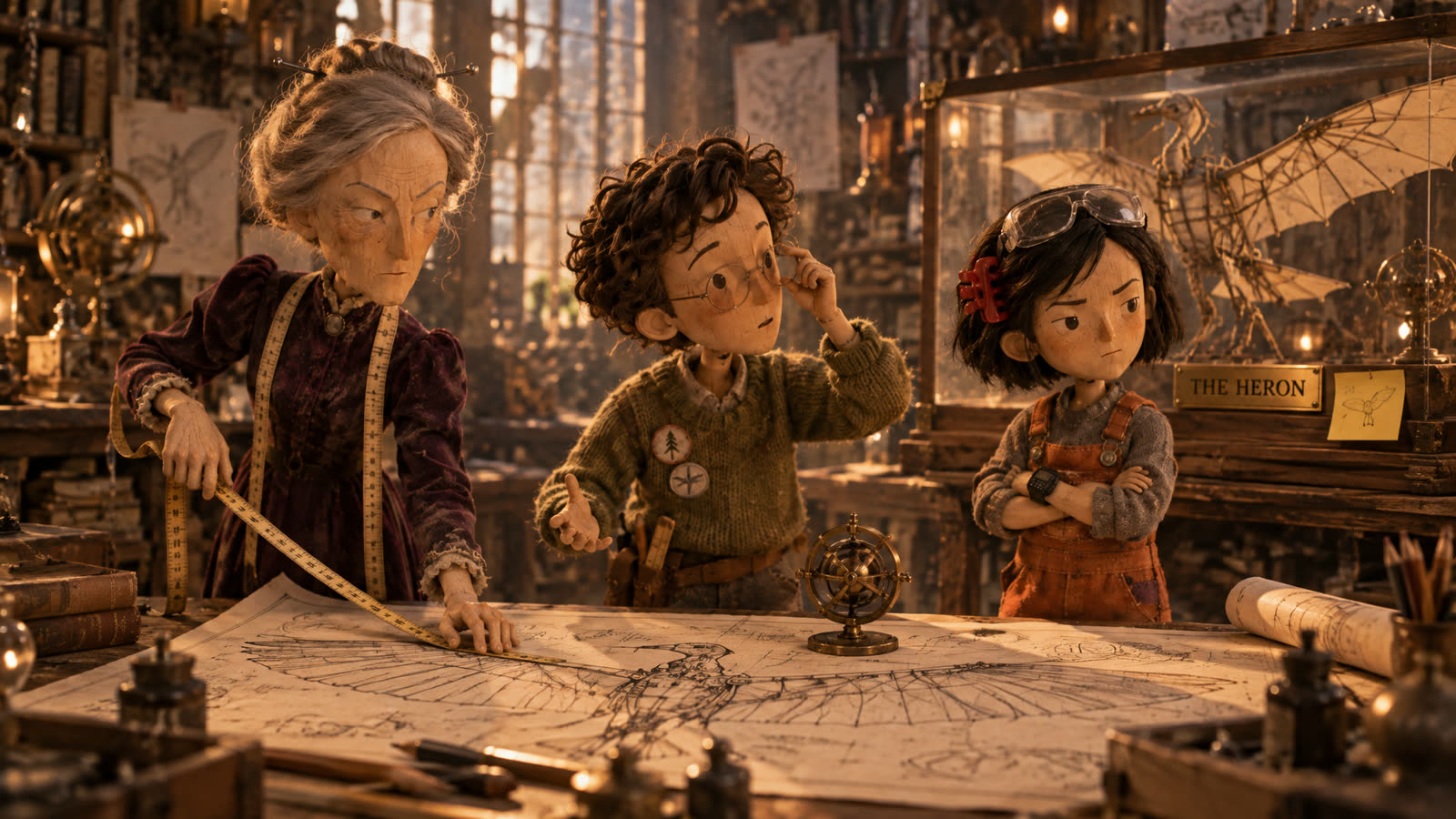
An eighty-four-year-old and a twelve-year-old rub out each other's lines.
“This is wrong.” “It's wrong in an interesting way.” “That's the only kind worth fixing. Sit.” Across the room, on the brass plaque, a yellow note in knife-sharp ink. Over it, still arguing: “Again.”
Made by hand, finished with care.
A hybrid stop-motion. The images in this deck were developed with makr.ai to lock the look, the cast and every set before anything is built. The film then puts real hands where the story says hands matter.
Built and animated by hand
- Hero puppets: Theo, Eleanor, Adela, Priya
- The long table, the staircase, the boiler room
- Eleanor's hands, the tailor's tape, the sticky notes
- Practical origami for every bird in close-up
Made with makr.ai
- Look development, boards and animatic
- Set extensions: the lawn, the forty windows
- Multiplying the flock from hand-folded plates
- Temp voices and the audio-drama edit
The voice cast
Human actors for Eleanor, Adela, Theo, Priya and Arthur, recorded together so the whispers overlap.
Filmed table reads
The cast around a real long table, filmed as reference for the animators' performance.