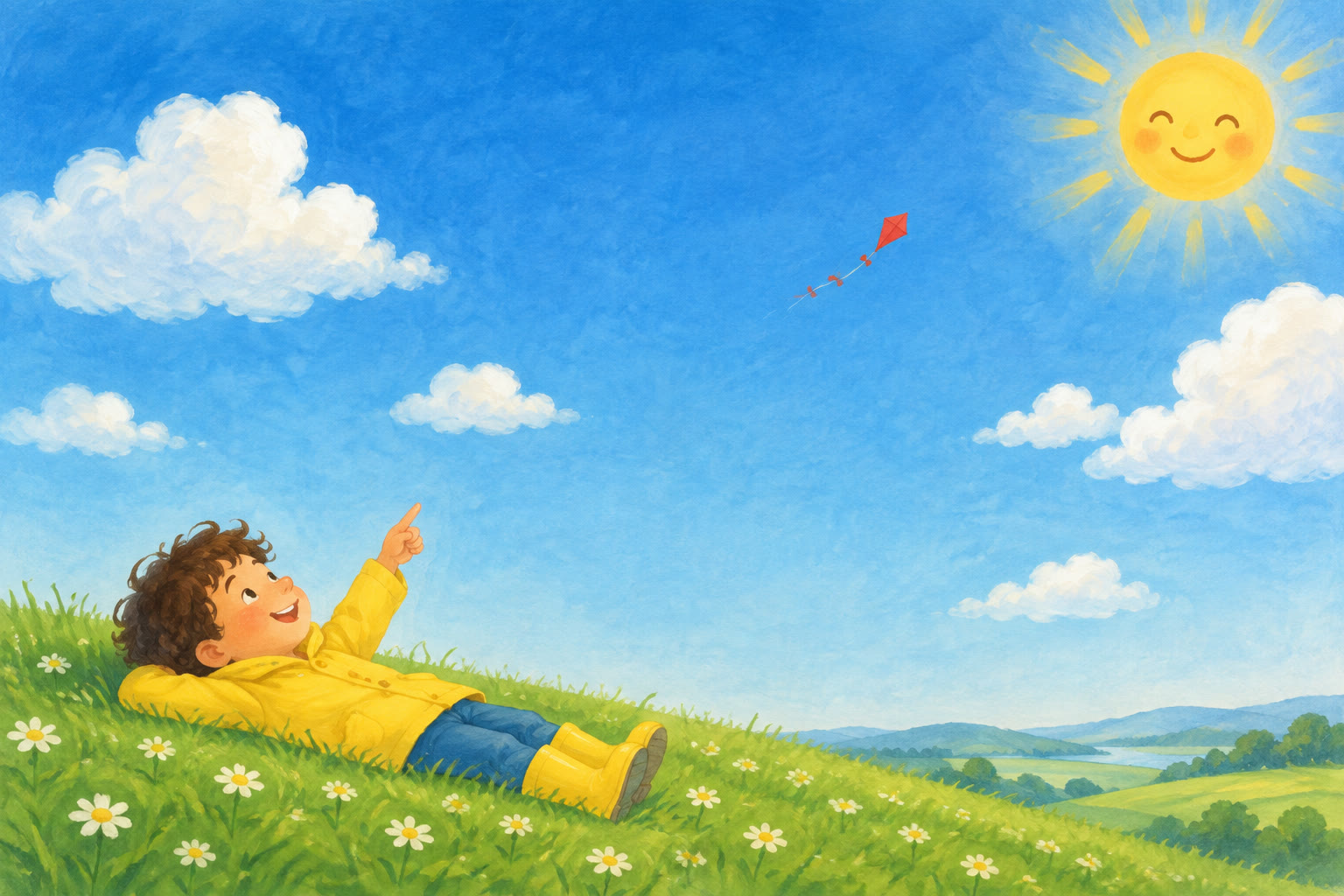
A child in a yellow raincoat lies on a grassy hill, pointing up at a bright blue sky with a smiling sun and a red kite.
Tiny Scientists · Lesson 3

Why is the sky blue?

Today we become sky detectives.

2nd grade15 minutesHands-on activity
Let's wonder

What color is the sky?

Is it always that color?

Turn and talk!
Morning
Noon
Sunset
Cloudy
Night
Clue #1 · Light

Sunlight is secretly
ALL the colors!

looks white a prism

The colors mix together and look white.
A rainbow is sunlight, un-mixed!

Clue #2 · Air

Air is full of teeny, tiny bits.

They are much too small to see, but they are all around us, all the way up into the sky.

More than 100,000 of them in a row could fit across one hair!
Science wordparticles teeny, tiny bits of stuff
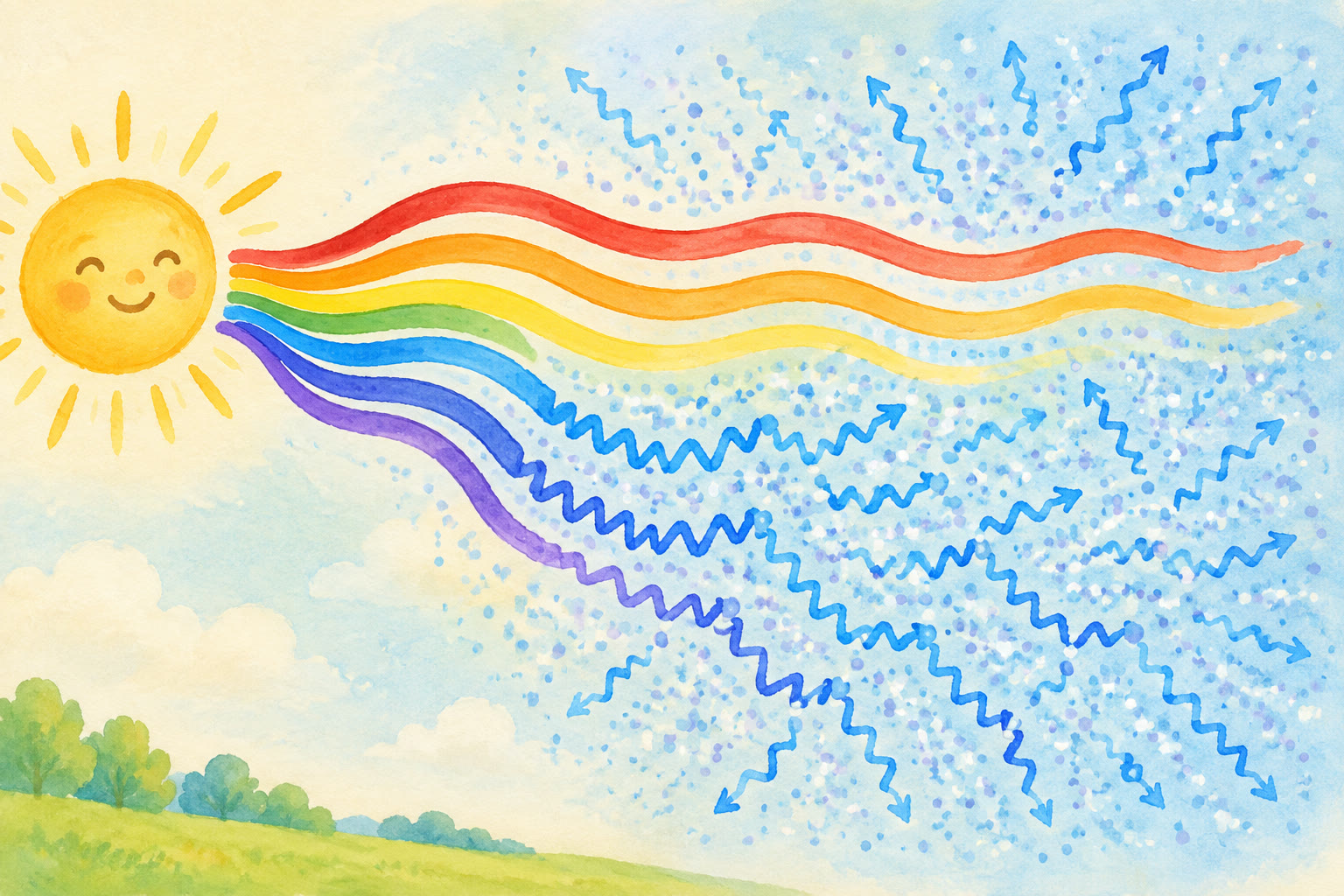
Painted sunlight as rainbow ribbons: red, orange and yellow glide straight across while blue ribbons zigzag and bounce off tiny air bits all over the sky.
Clue #3 · Bounce!

Blue light bounces around the most.

Red has long, lazy waves. It zooms straight through.

Blue has short, wiggly waves. It bounces off the tiny bits of air, all over!

Science wordscatter to bounce off in every direction

What about purple? It bounces too! But the sun sends us less purple, and our eyes notice blue much more.

Case closed!

So blue light comes at us from everywhere.

Look up anywhere, and bounced blue light is zooming into your eyes. That's why the whole sky looks blue!

MYTH BUSTER

"The sky is blue because it reflects the ocean."

Nope!

The sky is blue over deserts and mountains, far away from any ocean. It's the air, bouncing blue light!

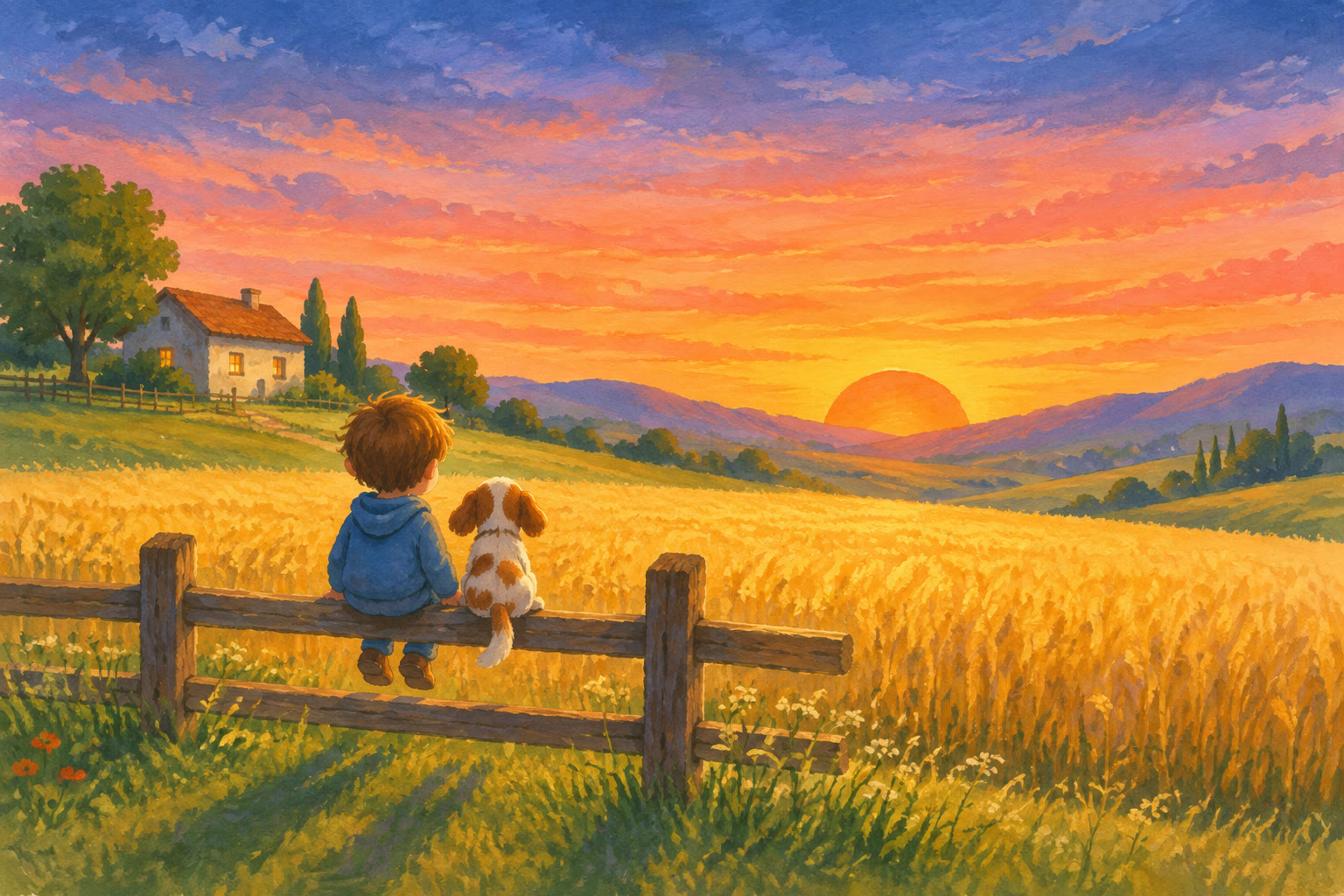
A child and a puppy sit on a wooden fence watching an orange sunset glow over a golden field.
Bonus mystery

Then why are sunsets orange?

  1. At sunset, sunlight takes the long way through the air.
  2. Blue bounces away before it can reach us.
  3. Reds and oranges make it all the way to our eyes!
the air Noon: short trip Sunset: long trip you

Hands-on · 4 minutesTry it! Make a sky in a glass.

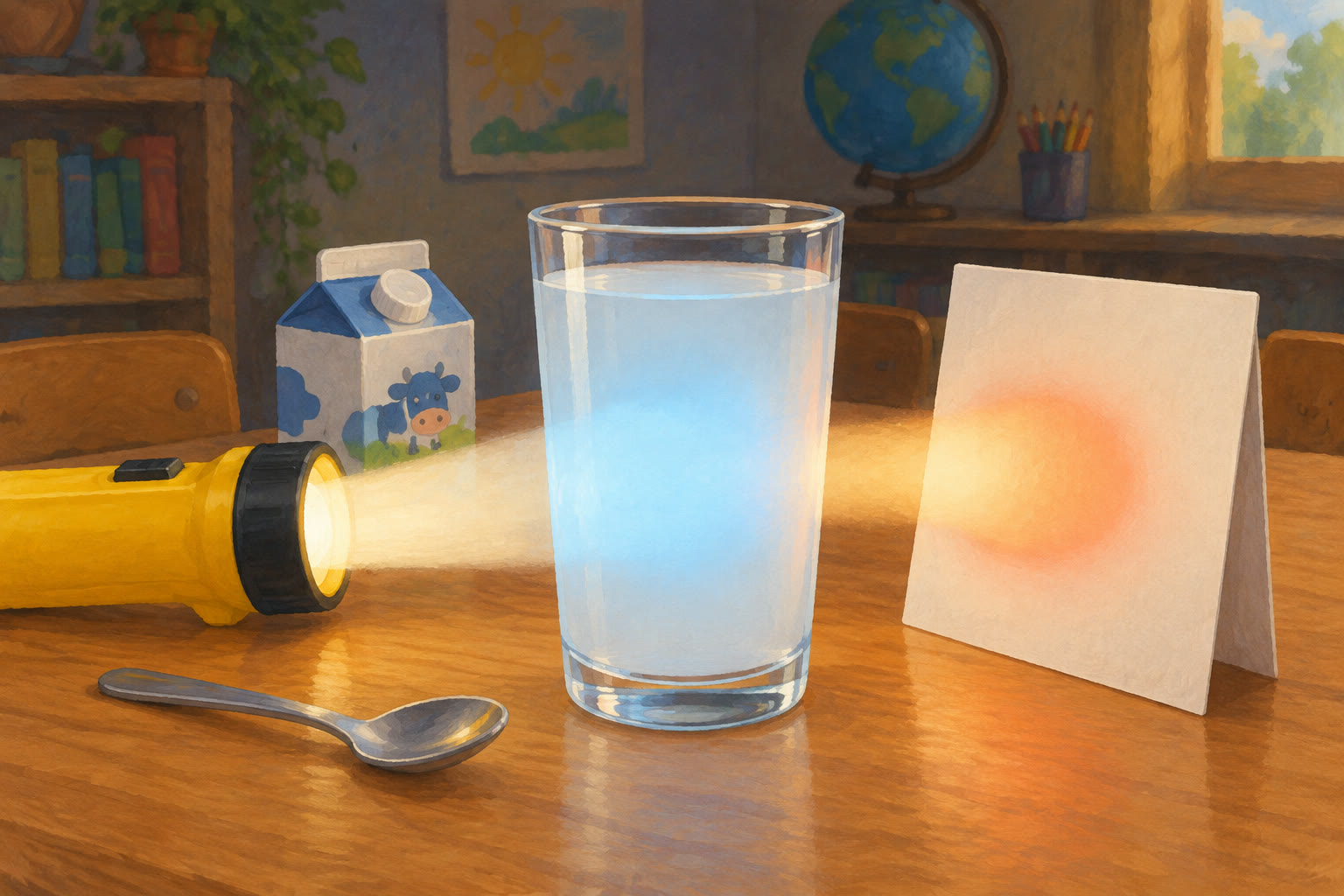
A flashlight shines into a glass of milky water. The water glows pale blue, and an orange spot of light lands on a white card behind the glass.
Clear glass or jarWaterMilk (a few drops)SpoonFlashlightWhite card
  1. Fill the glass with water.
  2. Stir in a few drops of milk. Just a little!
  3. Turn down the lights. Shine the flashlight into one side of the glass.
  4. Look at the glass from the side. What color do you see?
  5. Hold the white card on the far side. What color is the light spot?
Safe scientists: never shine a light in anyone's eyes. A grown-up handles the glass. This is a science drink, not a snack drink!
Scientists share

What did we see?

1From the side, what color was the water?
2What color was the spot on the card?
3Which one was like noon? Which was like sunset?
4The milk bits were pretending to be ... what?
The big idea

The sky is blue because tiny bits of air bounce blue sunlight all over the sky.

Say it with me, then say it to a friend!

Exit ticket

Draw the sky two ways.

The sky at noon
The sky at sunset
Add the sun! Bonus: draw an arrow to show where the blue light goes.

Teacher notes

Tiny Scientists · Lesson 3 · 15 min

Timing

1–2Hook: sky colors, turn and talk1.5 min
3–4Clues 1 and 2: sunlight has all colors; air has tiny particles2 min
5–6Clue 3: blue scatters most; myth buster2.5 min
7Sunsets: the long trip1.5 min
8Activity: sky in a glass4 min
9–10Share what we saw; choral big idea1.5 min
11Exit ticket drawing2 min
Total15 min

Prep (5 min, before class)

  • Test first: start with a few drops of milk in a tall glass and add more until the side glows faintly blue. Too much milk just looks white.
  • A bright, narrow flashlight works best (a phone light works). Dim the room.
  • One demo glass up front, or one per table group with an adult.

Vocabulary

light
What the sun sends us. Sunlight looks white but is a mix of all the rainbow colors.
particles
Teeny, tiny bits of stuff. Air is made of particles far too small to see (mostly nitrogen and oxygen).
scatter
To bounce off in every direction.

The science, checked

  • Rayleigh scattering: gas molecules far smaller than light's wavelength scatter short wavelengths much more (strength ∝ 1/wavelength4). Blue (about 450 nm) scatters roughly 5 to 6 times more than red (about 700 nm).
  • Why not violet? Violet scatters even more, but sunlight carries less violet, some is absorbed high in the atmosphere, and our eyes are much more sensitive to blue.
  • Sunsets: near the horizon, light crosses much more air, so most blue is scattered out of the beam; reds and oranges remain.

About the milk model

Milk droplets are much bigger than air particles, so the glass is a model, not a perfect copy. It still shows the key idea: from the side we see scattered blue light, and the light that travels all the way through turns orange, like a sunset.

Watch for

  • "The sky reflects the ocean." Redirect with slide 6: skies over deserts are blue too.
  • "Blue light is the only color in the sky." All colors are there; blue is just bounced around the most.
  • "Then why are clouds white?" Cloud droplets are much bigger, so they scatter all colors about equally.

Sources

NASA Space Place: Why Is the Sky Blue?
spaceplace.nasa.gov/blue-sky

National Weather Service (Flagstaff): Why Is the Sky Blue?
weather.gov/fgz/SkyBlue